Did you know that the majority of spiders in your home right now, are male? A study was done by the University of Gloucestershire and Charles Darwin House, and it showed that 82% (which is 4 out of 5) of the spiders in your house are male, and it’s because they’re basically bar hopping looking for the next pretty long legged lady.
I’m slightly less level headed about seeing spiders in the house than I used to be, since one fell from the ceiling as I was sitting at my parents kitchen table, and crawled in my ear…
… spiders, and bugs in general, don’t bother me as long as they understand that if they stay away from me (and definitely out of my ears), that I’ll stay away from them, or at least re-home them to the garden.
So, how does my traumatic bug experience lead in to Day 4? With three-dimensional fauxidermy insects.
When I was a kid, my parents had a framed set of pinned butterflies on the wall. At some point over the years, it was carefully retired to the loft because it felt cruel. I never know how I feel about pinned butterflies, on one hand I love seeing these creatures up close, butterfly wings being made up of minuscule scales that look like iridescent shingles or tapestry stitches and that fascinates me. But on the other hand, if you don’t know where they’ve come from, are they culled or found dead, is it right to have them on your wall?
Every time I go up into the loft, I look at them, dusty and unloved, and it feels kind of sad to have them hidden away, but I also can’t quite resolve my feelings about them. My parents however do still have butterflies on the walls, two huge ones that I made out of wool a few years ago. They’re both a little under a meter wide, a bit bigger than your average butterfly, but resurrecting them from hideous ex-window display items covered in pale green yellow sisal, I think it’s a vast improvement.
(I realise this is a tragic photograph, the lighting is not great in a narrow hall and there’s no chance I was going to attempt taking them off the wall because
I’d inevitably not get them back up, and just to top it off every time I tried to size it the image quality dropped. Yay! But here are my butterflies anyway.)
Bug decor is a definite yes, and paper fauxidermy, is starting to become a favourite…
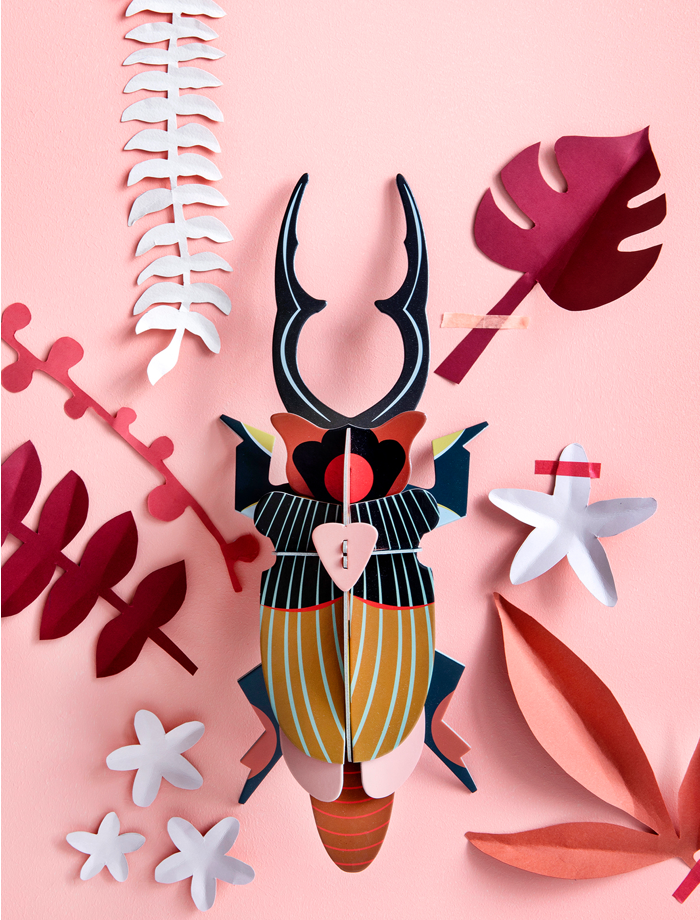
Giant Stag Beetle
Amsterdam based Studio ROOF, create these large insects out of recycled cardboard, printed with plant based inks which they sell as kits which slot together. Which is amazing, they’re simple, colourful and easy to put together - my little sister has had three of the kits and they were a doddle - and they make really nice pieces of three dimensional wall art.
Longhorn Beetle
(Yes, I may now have to make a giant type-case full of giant bugs. What did I say about being weak for a new craft? Apply that to anything displayed in a type-case too.)
Lady Beetles
Comet Moths
Not limited to insects like stag, scarab, shield and longhorn beetles, Studio ROOF also produce butterflies, moths, dragonflies, flowers, sea creatures, birds and jungle animals, basically any nature inspired design you could think of, and while they’re not painted to be realistic, they’re minimal patterning and use of colour blocking make designs which really stand out.
Another brand that sends you insects pre-squashed from the Netherlands are Assembli. Created by designer Joop Bource, the flat pack bugs employ a similar design to that of Studio ROOF, with slotting pieces of cardboard to create a three dimensional skeleton. However, they then rely on folded metallic paper to create the exoskeleton, adding even more three dimensionality and realism.
Assembli refer to their kits as puzzles and projects, shunning the idea that these are merely products to be purchased and displayed, but instead are something that the recipient is creating themselves. They may be pre-cut, but they take time and effort to build (45 minutes according to Bource) and that should bring the owner just as much pride for creating it, as joy for owning it.
The pride you feel having something you’ve made hanging on your wall, whether it’s from scratch or from a kit, making something is ridiculously fulfilling. And it hits just as hard when you’re an adult as when your mum or dad pinned your drawing on the fridge or hung that janky looking Christmas decoration on the tree when you were a kid.
I want one of these kits, I want to sit for forty-five minutes putting it together and then get to hang it on the wall or sit it on a shelf and have that paper bug make me feel good about doing something creative just for fun, without the pressure of everything else. Because I’ll always be that kid coveting the magazines with kits, and choosing an art kit or a toy.
Moving less than couple of hundred miles down from Amsterdam, you end up in Belgium, not only where part of my family tree comes from, but the home of the multidisciplinary design studio and ad agency, Soon.
Working with IGEPA Belux, one of the leading paper merchants in Belgium and Luxembourg, Soon were challenged to make the company stand out amongst their competitors, especially in relation to their ecological impact. Alongside highlighting the companies new line of recycled paper, they were also challenged to use the brochures for these products as their medium for creating the advert, new visual identity and branding.
They did this by painstakingly hand-making a paper insect for each paper in the line.
I didn’t really appreciate these paper cut insects properly, aside from how pretty they are, until I saw the making of video and could see how the designers brought these insects to life and created lush paper environments, full of plants and flowers for them to interact with.
That said, I love the delicacy, the lacy wings and the shingled bodies and I’d have one of the yellow bugs in a frame on a wall in a heartbeat.
A hop, skip and a jump across the English Channel and back to the UK, with probably the most intricate and meticulously assembled handmade insects of the bunch.
Created by UK based paper artist Lisa Lloyd, these insects are made up of thousands of hand cut pieces of coloured paper, layered onto inner skeletons formed out of card, paper and tissue and all held together with glue. This designer is old school, it would be so easy to have a counter full of laser cutters programmed by a computer, making sure that each piece is pre-cut and ready just to be glued together, but instead it’s Lloyd, scissors and scalpel blade after scalpel blade to add to her tin of blunt ones. Something every crafter probably has stashed away somewhere in their supplies.
Lloyds insects are some of her more intimate creations. They’re small in comparison to her larger, swirling birds and animals, which are dynamic, full of movement, colour and life, but despite their diminutive size, they’re full of incredible detail and their forms are instantly recognisable as the creatures they’re inspired by.
The intricacy is amazing. These tiny geometric shapes placed on the bee’s body like shingled gives enough of a fur texture to mimic the hairy body of a bee, and the lattice cut out of the wings brings the lightness and lacy quality of bug wings, and without either needing to be replicas in texture, colour or sheerness, you know what they are. And the pastel colour make them unique, and give them a brightness which is incredibly attractive.
Once an extraordinary number of hours and attention to detail has been spent on each piece of paper art, Lloyd takes photographs of her work so she can sells them as prints, have them featured in magazines, advertisements and TV, and after such extreme amount of time and effort is taken on one piece, it’s an incredibly logically way to all more people to enjoy her art.
Cardboard, paper, some cutting, some folding and maybe a little glue, the same things we used as kids, and it can do such a lot. Two of these were pre-cut kits and two were hand cut piece of artwork, but they’re all connected, they all have unique interpretations of not only insects, but of three-dimensionality.
And that’s what I like about these, yes some are more beautiful, more detailed, even more artistic than others, but they all rely on mimicking that robust form a lot of beetles and insect have to protect themselves, and I’d rather pin a paper bug to my wall, or in a frame, than a real bug.
This is something I really want to do for my own space, I love the kits, particularly the Assembli ones, but I also love the idea of using textiles, 3D printing or just creating my own cardboard or paper bugs. Maybe not quite on the same scale as my butterflies. Though I’m also coveting these amazing brass beetles, as well as a brass mirror beetle, and a brass bee door knocker… researching this sent me down a rabbit hole of brass bug based decor and I’m in trouble.
Anyway, good afternoon, good evening and goodnight! Part five is fluttering in the room somewhere, go grab a butterfly net and I’ll pin it down!
... ten tiny treats... ... nine creative weirdos... ... eight things I loved... ... seven shoes to choose from... ... six party dresses...
... five gold rings!..
... four favoured films...
... three rosy bubbles...
... two iterations...
... and a tale for tugging heart strings.
For a couple of years now, I've been almost posting something. And then never really finding the right way to include it because it's kind of weird, but when I first ready about it, I thought it was the most curious thing.
The thing was the Nutshell Studies of Unexplained Death...
... I'm not intending to do a post about true crime, or zombies, or anything gruesome, it's just my jumping off point for Day 10 and creative miniature worlds.
The Nutshell Studies of Unexplained Death are a series of eighteen (though there were originally twenty) intricately handmade dioramas, representing crime scene, recreated by Frances Glessner Lee, who was also known as "the mother of forensic science", between 1896 and 1949.
Nutshell Studies of Unexplained Death || "Red Room" || Photo by Lorie Shaull
Nutshell Studies of Unexplained Death || "Log Cabin" || Photo by Lorie Shaull
"Convict the guilty, clear the innocent, and find the truth in a nutshell."
- Frances Glessner Lee
The viewer is looking at the crime scene at the moment the police officer arrives at the scene, a composite of actual cases out of history, they're purpose to help train homicide detectives how to assess a crime scene and discern between the relevant and irrelevant evidence within that space. These were from a time were the standard practices you see within crime scene investigation didn't exist. Real crime scenes would be disturbed, evidence including weapons and bodies moved, no gloves or means to prevent contamination of the scene, thus hampering investigations. The Nutshell Studies showed the importance of everything remaining just as it was when the police arrived and proved that you didn't need to enter a crime scene and root around to solve it, you could learn just as much if not more by just looking.
Nutshell Studies of Unexplained Death || "Dark Bathroom" || Photo by Lorie Shaull
I find these dioramas kind of fascinating in a macabre kind of way. But the detail Glessner Lee put into them, down to knitting the tiny stockings worn by the dolls, in a time when women didn't go to university, is incredible and she used her hobby and interest in crime scene investigation, to form a means of education, when none really existed prior. An heiress, she used her inheritance to established the Department of Legal Medicine at Harvard Medical School in 1936, donating her first Nutshell Study in 1946.
While the department, the first in the US, was dissolved in 1966, the Nutshell Studies found at new home, educating officers at the Maryland Medical Examiner's Office in Baltimore, and seventy years later, they're still in use.
Which is incredible for grim little murder houses.
From murder scenes to post-apocalyptic urban landscapes, and much like the Nutshell Studies, these dystopian scenes by artist Lori Nix and partner Kathleen Gerber, are all about the mundane environment after human life has gone.
And they are impeccably detailed.
Nix+Gerber || "Library" || 2007
Nix+Gerber || "Botanic Garden" || 2008
Nix+Gerber || "Church" || 2009
Nix+Gerber || "Mall" || 2010
Working together since 2005, Nix+Gerber take approximately seven months to create each of their dystopian dioramas called "The City" from start to finish. Their end result not only being a beautifully detailed model, but a perfectly curated photograph placing the viewer within that world without digital manipulation. Because the process for each miniature takes such a long period of time to produce, this results in the duo taking just two photographs a year, which is insane, but when you think about the immense amount of time and precision it takes to replicate every minute detail, it's also not surprising.
Creating everything they photograph, this became a meta experience with the ultimate nod to a future without human life, with their own artists studio being the subject without its inhabitants. They recreated every book, every CD, all their craft and art supplies strew around, their blinds and curtains half shut and extension cords running from one area of the studio to the other, even the previous miniature (recreated as a micro miniature) left abandoned on their desk, Nix photography equipment still in position.
Nix+Gerber || "Living Room" || 2013
Every piece of craft and clutter abandoned as though the world had ended and it was left to sit and decay... sounds a bit like my workshop.
Once the photograph is taken, Nix+Gerber destroy the models. They salvage any reusable materials or items they've made for future projects before dismantling the diorama, and thus months of painstaking work is only remember in a single image.
I think these are epic. I might be being swayed by my penchant for dystopian aesthetics in TV and movies, but it's the detail. These aren't just dioramas or dolls houses, they're statements about how the natural takes over the man made and how practical illusions are often more impressive and dynamic than digital ones.
Lori Nix is not alone in using miniatures as a means of curating the perfect photograph before deconstructing months of work and starting over.
However, unlike Nix's foreshadowing dystopian landscapes, Matthew Albanese creates hyper realistic landscapes made out of everyday objects ranging from grout, glass, moss, feathers, cotton and faux fur, to ground spices and sugar, which he uses in all forms possible to give different textures to his work.
Albanese's project entitled "Strange Worlds" features weeping willows made of ostrich feathers, hand dyed and glued to the trees branches allowing to move and sway as the air around it moves. The surface of Mars is layers of paprika, cinnamon, thyme, nutmeg and chilli sifted over chunks of charcoal, while glacial landscapes are made of kilograms of sugar cooked to different temperatures to achieve different textures which mimic the icy formations which have naturally broken and cracked as its moves and melts. Even grasslands are made of faux fur instead of more traditional model making materials such as static grass, allowing it to be brushed and blown into natural undulating formations.
Movement, lighting and forced perspective are at the upmost importance in Albanese's miniatures because they bring life and drama to a static object. One image can be lit in as a beautiful golden sunset in one image and then grey, dull and stormy in another, with a fan manipulating the leaves of a tree or the way water appears to move.
It's clever and the detail he puts into his models, and the lighting, and the fine details, end up with really emotive and realistic photograph that at first glance, you wouldn't necessarily clock. A lot of this is down to his abilities as a photographer, but being able to choose materials that will mimic natural objects but in miniature, is really impressive.
It still makes me cringe a little that after all the work and time that these artists put into their work, that they're just dismantled. I realise that for photographers like Albanese and Nix, it's all about the photo and the diorama is just a means to an ends, but the crafter in me just feels like these models are just as artistic and beautiful as the final product, and it feels like such a waste to bin them.
I'm a craft hoarder though. I made a tiny shoddy mock up of the letterbox for the window at work, which barely stood up, was held together with tape and was wonky as hell, but I can't get rid of it yet. If I've made a maquette for something at any point in my life, I've probably held on to it for years afterwards. But I like model making to design over drawing, so I can't help the hoarding.
Hyper-realistic dioramas are impressive, they're full of detail and precision, but they're also replicating either existing places or amalgamations of places out of any and all material which give the most realistic effect.
Limiting yourself to two or three materials, a knife and your imagination may outwardly appear incredibly simplistic in comparison, but I find it as beautiful and more joyous.
Charles Young's Paperholm began life as a 365 Day creative project in 2014, the architect/artist challenging himself to create one miniature architectural model a day out of 220gsm watercolour paper, PVA glue and a base made of small blocks of wood or stones. On top of this to add whimsy, there are curiosities lurking amongst the paper buildings, dinosaurs, anteaters and many moving parts pop up and allowed Young to create quick animations within his simple architectural models.
These miniatures appeal to me almost more than anything else on this list (so far). They're simple and silly. They're made of watercolour paper and glue. I love those things. Plus they're rooted in different architectural styles and eras, and I love the idea that it's the artist working through his designs through such simple materials and creating something bigger and better. Young took the design tool he preferred - modelling - and turned it into art, animation and a world.
As much as I appreciate and love the hyper-realistic, I'll take this in a heartbeat.
Paper isn't an unusual material for making models. It's probably one of the first materials most artists and designers turn to when creating, whether that's for drawing or making a miniature of their final piece, and that's because it's readily available, cheap and recyclable. But a lot of artists - obviously - choose this as their material of choice from the get go, to great effect.
Malena Valcárcel || "Living on an Olive Branch"
Malena Valcárcel || "Living on an Olive Branch (Detail)"
Malena Valcárcel recycles the pages of old books into beautifully delicate intricate sculptures. She started with a piles of books she had read and no longer wanted - sacrilege among the book obsessives in my household - and quickly as she used these up, she began searching for used, cheap books she could buy, but also using those that were donated too her by others. These are broken down and turned into pieces of artwork, some perched on pieces of wood and others emerging from the pages of these second hand pieces of literature.
Malena Valcárcel || "Treehouse Book Art"
Malena Valcárcel || "Treehouse Book Art (Detail)"
Malena Valcárcel || "Treehouse Book Sculpture"
Malena Valcárcel || "Treehouse Book Sculpture"
Malena Valcárcel || "Treehouse Book Sculpture (Detail)"
This style of sculpture isn't unusual, there are many artists who utilise old books for their artwork, the most well known probably being Su Blackwell who's work has been used in books, advertisements and window displays to great acclaim, and has become synonymous with book art. Another example is the literary book sculptures left in cultural locations around Edinburgh between 2011 and 2013 by an anonymous female paper sculptor. However Valcárcel's have a beautiful quality that I personally love.
Am I going to ransack the house of books for paper? Would you be surprised to know I kind of did. I had dozens of crappy chick-lit novels I'd read as a teenager and wanted rid of, but wanting to save people from the same reading mistakes of my youth, I decided to dissect them for materials... only problem was every page I used ended up either being covered in curse words or questionably written sexual acts. Needless to say if/when I use the paper, things will either need painted or heavily redacted.
Choose the books you want to recycle carefully because without fail the most inappropriate text will always end up right where it's most visible.
For those less inclined to ransack their bookshelves for materials, but instead want to carefully curate their library, book nooks may be a perfect way to slip a miniature diorama into your world.
u/macksdhart || "Endor"
During one of my Monthly Ramblings last year, I posted about a Japanese artist called Monde and the back alley dioramas that were made to fit between two standard sized paperbacks on a bookshelf, often including an angled mirror, to trick the eye into thinking the void housing the diorama is significantly deeper and bringing greater depth to the sculpture. Those were created in 2018, a year later the idea started to become popular among people posting on Reddit, and the subreddit r/booknooks jumped from no members to nearly eight thousand in just two days. It's now hit twenty thousand subscribers. The creative weirdos of the world are really embracing this new and intriguing art form.
The nice thing about Book Nooks is that they can feed the literary fan's fantasy by transporting you into either a random little world, or one that's part of those worlds created within the pages of your favourite book, Diagon Alley from Harry Potter being a prime example.
Again, I come from a book loving family, so for them the idea of destroying a book is sacrilegious. However the idea of having a little slip of a diorama, lit within the space between two books - given we also have a familial penchant for fairy lights - most definitely will appeal.
And before you ask - not that you did, but I know at least two members of my family will be getting ideas - I've already got an idea for making one these based off of the first introduction Sarah has to the maze in Labyrinth. And yes, there will be lights, but more importantly there will be glitter. So much glitter!
Containing a miniature within a box seems like a pretty sensible concept, it creates a contained vignette letting the viewer peer into another world.
Shadow boxes - akin to traditional picture frames but deeper - are the perfect carrier for these models and artists such as Andy Acres have taken this style of diorama to a beautifully eerie end.
Andy Acres || "Derelict Greenhouse Shadow Box"
Andy Acres || "Derelict Greenhouse Shadow Box (Detail)"
Acres' hand crafted dioramas of creepy locations and derelict buildings, abandoned and allowed to become overgrown by the world around them and back-lit by dim foggy light, which creates this spooky, threatening atmosphere within his work. They're oppressive, yet strangely inviting.
Andy Acres || "Bad Harvest in the Hollow"
Andy Acres || "Beyond The Garden"
Andy Acres || "The Witch, Banished in 1861"
A trained illustrator, Acres creates an initial sketch of his dioramas which he then translates into the three dimensional world, paying meticulous attention to every detail to create hyper realistic snapshots of these moody environments.
My favourite by far is the greenhouse. The interior viewpoint with overgrown vines and trees and that dim, foggy light creating shapes on the broken panes of glass is really effective. I love the aesthetic of abandoned buildings, and Acres has managed to capture in this diorama that feeling of decay. First glass breaks, paint flakes away, wood rots from water damage, brick cracks, leaves gather and plants gradually creep inside, as the bones of the building start to become visible. The skeleton of the building's still there, if you were standing inside that greenhouse you'd still feel protected, but only just, it wouldn't be comfortable, and Acres has really captured that. It's wonderful.
Telling a story is a huge part of the art of dioramas, Whether it's so a crime can be solved, a predicted future can be forecast or a sense of uneasiness can be created, the story or an emotional response has to be crafted by the artist, by hand, within inches of space. In many respects it's no different than creating a set design for a movie or the theatre, they need to feel natural, organic and give over more information about the story than the viewer is actually aware.
While you could look at Marc Giai-Miniet's and simply see the beauty in the multi-level library, crammed with row after row of books, lining the walls, colour creeping in as your eye descends down towards the dark bleakness of the soot stained basements, the meticulously designed dioramas hold a darker story within them.
There are piles of parcels, suitcases, files, some of the dioramas have laboratories hidden within their floors, others furnaces, mining tracks with bins to take things away and submarines for escape. It would be easy to imagine these were bunkers from some dystopian future, an archive of literature and information carefully curated by the dwellers who reside beneath the ground and who may or may not still be there. But Giai-Miniet's influence is partially drawn from his childhood and visiting his father while he worked as a mechanic in a garage, however there's undeniable link aesthetically to the the Holocaust, and how the Nazi's would seize and catalogue the personal belongings as people were were brought into concentration camps.
Giai-Miniet talks about his dioramas being a metaphor for the human condition.
“From the whiteness of books to the darkness of sewers, there is a never-ending to and fro between the two main poles of humanity: bestiality and transcendence, human fragility and inaccessible divinity.”
When I first looked at these, I just thought they were wonderfully weird cross sections of library-like bunkers that looked like something from the set of a movie or animation. A monochrome interior you might see in a Wes Anderson movie. However having read more about the hidden narrative, I'm actually even more impressed by the story that Giai-Miniet has managed to cram into these amazing dioramas.
As a hobby, there is a great and long standing tradition in model making. People create lavish scenes for model trains to run, hand making elements while utilising the wide variety of model making materials that are available.
I've always been a little fascinated by the moss trees, static grass and little people and I walk past the materials in craft shops and am intrigued but have no idea what I would do with them.
Unlike Australia based artist and model maker Kendal Murray, who utilises these tiny figurines and traditional techniques to build tiny whimsical worlds, that captures a moment in those characters lives, but in a unique way.
By creating her tiny dioramas atop compact mirrors, old wooden shoe forms, purses or within the confines of a teapot, she transforms them into ponds, grass covered fields and hillsides, all shaded by lichen topped trees... I don't know why, but I've always loved these kinds of trees, and they bring realism into the scenes, as does the way she's applied static grass to undulating surfaces. Confining the dioramas to these objects not only brings form to the landscapes, but familiarity.
The figures add whimsy and silliness, but I like that. You need the scale and action of these tiny characters to help tell a story. Whether that's of people climbing rocks or a hillside, children playing or someone being chased by a goose, it's the combination of traditional craft, humour and curiosity that makes these really interesting and fun.
"There are three words in the English language, and three words only,
that begin with the letters DW [...] Can anyone name them for me please?"
("Mr. Willis of Ohio" || The West Wing || Season 1, Episode 6)
The answer is dwindle, dwarf and dwell. Throughout writing this post I've had that particular scene from The West Wing in my head, where the staff are playing poker and President Bartlet's trying to distract them by asking inane questions. I'm a huge West Wing fan, and watched the show back over Christmas, so it's not unusual for me to have quotes from the show in my head, but the reason this one's kept circling is because for the majority of this post, and the ten artists I've featured, I've been writing about tiny dwellings.
And these of all the dioramas and tiny dwellings I've written about, are probably my favourites and though I've probably said that before in this post - I know I have - there's something about the "Somewhere Small" series of treehouses created by prop designer and ceramicist Jedediah Corwyn Voltz, that I feel really drawn too.
These miniature treehouses nestled within the branches of house plants are simply and utterly delightful.
“Building miniatures for stop motion always leaves me with a huge bin of scrap balsa, basswood, various fabrics, etc. and I found myself making little fantasy constructions out of that stuff during my downtime. [...] Those little scrap forts led to me building some more serious ones in little diorama settings, and last year I built my first living treehouse. Since then, I’ve made almost 25 of them, from tiny watchtowers in secluded forests, to quiet treetop meditation platforms, to giant bustling windmills and waterwheels.” (Jedediah Corwyn Volt, Bored Panda, 2017)
Made out of bits and pieces of random scrap materials, with tiny ladders, roof tiles, furniture and bunting, they are just this beautiful combination of ramshackle and detailed. And having them constructed within the limbs of different succulents is a really effective and attractive way of creating a diorama and have it anchored in reality, rather than the artist creating a world around it.
There are definitely three plants I own that I would really, really like to do something like this around. Not that I don't love the plants on their own, but I love the whimsical joy that something akin to Voltz work would bring. Plus it's a creative challenge to building a treehouse out of the scraps of materials around the house. It'll be a fun way to while away a few hours.
So, when I started writing the bulk of this post I was going to mention how everyone was feeling better, getting over the cold. That is except for Charlie, who was being the definition of man flu in cat form, sneezing up a storm, being sad and stroppy and incredibly cute as he had sneezing fits. Which while it was funny - he's back to his sassy self again - it doesn't seem wonderfully appropriate now.
Neither does the fact that half of these miniatures revolve around dystopian, human-less environments, seeing shop shelves are becoming bare, people are panicking, and most of the world is in isolation trying to stem the spread of the Coronavirus (COVID-19).
I'm not going to say much about it, I think anyone who blogs or posts on social media needs to try and stay positive because their content is probably providing their viewers a source of distraction and hopefully comfort. So, while it will almost certainly come up, hopefully it can prove just as much of a distraction for them as their audience, whether it's the usual content, or random activities done while isolating yourself. Plus, hopefully that by chatting in the comments etc, it will help people stay positive.
I've been trying to stay level headed about everything, but it's hard not to get in your head and panic about what's going on at the moment, especially when day to day the information out there just compounds everyone's fears.
My point is, I hope that my posting this and repeatedly talking about death and dystopias doesn't offend anyone. Obviously that's not my intention and I had these posts at least sketched out before any of this started and even while I was writing this, things still weren't looking so bad. Please just take them as something beautiful and interesting to look at rather than somewhat inappropriate content.
Just stay safe, as cliched as it is to say that, I know I have family, old friends and maybe a few other people reading this periodically and I hope you're okay, and that you're able to keep your family and friends not only safe but sane throughout self-isolation, quarantine or illness. However long this goes on for... hopefully it's not as long as my 12 Days of Christmas.
Too soon? Look, just listen to people a hell of a lot smarter than me (ie: the NHS, WHO and the CDC) and try not to listen to the the fear-mongers. Wash your hands while singing whatever 20 second song helps you (I like "Truth Hurts" by Lizzo or The Beatles "Her Majesty" which is almost exactly 20 seconds long) and just try and stay as normal and positive as you can, especially if you're on your own. Find things to do, spring clean, start a project you've always planned too, finish ones that you've left idle, and if you feel like you're freaking out, call someone, whether it's family or a friend, even if it's just to talk nonsense and take your mind off of things. This is coming from a socially anxious hermit, so you know that's good advice!
Now, let's look to something nicer. Happy almost spring! Part eleven before spring has officially sprung...