I love plants. I can’t go through the supermarkets without at least glancing at the pot plants, or go to visit my gran without plotting when and how I can take cuttings from the houseplant on her coffee table, so I can propagate them. Ironically my most recent snippets, from a Watermelon Peperomia I gave her for her birthday a couple of years ago, and one I have successfully propagated four plants from two leaf cuttings, has now a plant of mine that she’s coveting, since the mother plant is starting to look a little worse for wear.
That’s why I love propagation, you can share and re-share your favourite plants, grow an army of your favourites and keep ancient relics from your family tree alive. For example, the three yellow tree peonies I started growing, were seeds from my grans garden. I planted them more than over a decade ago, they took two years to sprout and this year, finally, they flowered.
Peonies can take between seven and eight years to be mature enough to flower, so for the past few years I’ve been waiting with bated breath to see whether they would be true to colour or not. Then these beautiful buttercup yellow flowers appeared and all that time waiting was worth it.
As are the hot pink flowers about to open on both my Christmas Cactuses, which are cuttings from one which belonged to my great gran, and is now a huge plant that lives in my grans house and every time my grandparents were away, I was charged with not killing. Only almost did once, but I blame a blistering hot summer and a south facing window.
This is my very long winded way of say that propagation is an amazing way to increase the number of plants you own, and acquire new ones from your existing plant babs, from friends and from family without having to go out and buy new plants. Though, it does open you up to looking for pretty pots and vessels in which to place your cutting while you’re waiting for them to root. So here for Day 3, one I covet, one I aspire too and one I’m almost there with…
Water propagation is my preferred method for growing cuttings, and the one I have the most success with. Mostly that’s because it is simple. All you need is a clear receptacle filled with room temperature water and pop it on your windowsill, changing it out once a week if you remember. If you’re lucky, you’ll see fine roots start to develop and once they’re a couple of inches long you can pot them up, and the worst case scenario is they die off.
But, while jam jars, glasses and vases are all excellent options, the lure of a pretty propagator is always a risk, especially - for me - when they look like little terrariums!
So, the objects I am currently coveting for propagating are these enclosed terrarium style hydro vases by [10¹²] TERRA, a Japanese design team comprising of Daisuke Tsumanuma and Kenichi Yamada, and these are designed specifically to show off the root system of plants. And as hydroponic growing becomes more popular, and I can understand why.
Simultaneously protecting the plant while exposing its delicate root system, making them look almost like displayed specimens, this type of growing system isn’t just good for propagating your cutting. With the right kind of plant, they can happily grow in water alone, dispensing with the need for soil, pot upgrades and the accompanying mess. It’s just a really modern and attractive way of growing plants in your home and for cuttings, can be filtered down from a beautiful vessel like this, to simply using a jam jar or vase.
Now for something I aspire to, and that is the beautiful, aesthetic and lush way interior designer, Hilton Carter, has decorated his apartment using hundreds of plants, cuttings and propagators.
Honestly, this is the stuff that plant lovers dreams are made of, and my knowledge of him stems from an interview and apartment walkthrough on YouTube and this wall of test tube propagators (known as Cradles, they are sold by Carter on his website in a variety of sizes and finishes) with its neon sign above, in a narrow hall.
I fell in love with this wall in particular, along with his apartments entire aesthetic I even went as far as buying his book, Wild at Home. It’s a beautiful way to create propagation station within a tight space, giving a permanent area for your cuttings, but also a way to really enjoy how beautiful the form, colour and shape of the leaves can be, even without the mother plant. Carter, who is also known as one of the OG plant influencers on social media, is showing how wonderful plants are as pieces of design within a home, but not only as someone who designs interiors for a living, but just as someone who truly loves plants and can’t live without them.
Plants in the home are wonderful and calming, they can improve your mood, they can improve the air quality of your space and I can’t imagine not having a home filled with them. But I aspire to create a wall like this one day, not only because it’s simple, yet stunning, but also because it’s achievable. Test tubes aren’t that expensive, and while Carter’s Cradles are beautiful, they’re also potentially DIY-able for those who don’t have the budget, so as long as you’re power-tool savvy, or know someone who is, you could easily bring something like this into your own design aesthetic without much difficult.
For that I found a tutorial by self taught carpenter, Jen Woodhouse, which gives a very similar aesthetic and I shall now be instantly adding to my future diy board on Pinterest.
Lastly, after something I covet and something I aspire to, I give you something I almost did. By that I mean that I did have the intention of creating a propagation system like this simple hanging vial and string set, even to the point where I have the tiny bottles. In fact these are what I do most of my propagating in these days, the small ones at least, there’s no way I could root an avocado in one of these teeny things, if I could I’d definitely be a witch.
As vessels for cuttings go, these are small, but really effective, and while I got them with the intention of stringing them together, I never did, I got ahead of myself and wanted to use them before I strung them together, and while I may string a few purely for the aesthetic, but it would ultimately be flawed for one reason, cleaning. By tying the vials together it would make them really hard to clean and do water changes, and since the only way I’ve managed to successful and thoroughly clean them is to soak them in Milton, a sterilising liquid used on baby bottles, which works like a dream when you can’t get a bottle brush to fit.
Thus, until I think of a work around, they will sit quite happily on a windowsill in amongst other pot plants and be the perfect size for little cuttings.
With the cold this winter, and everyone trying to keep the heating off as long as possible to save on bills, it’s not the best circumstances to start taking cuttings from your plants. But there’s just something really satisfying about growing a plant from a cutting, and water propagation is the simplest way you could get started without having to buy any vessels… even if it’s stupidly pretty and you can’t stop thinking about it.
A bit like how I can’t stop thinking about/am completely obsessed with the idea of emptying my antique type-case of all the nail polish and bric-à-brac it’s collected over the years, and filling it with polymer clay and paper miniature plants! Just because artist Hannah Lemon, posted the pictures of her beautiful handmade miniatures on display in one!
During this oh so lovely pandemic that we've been experiencing around the world, one positive thing that's happened is that there has been an uptake in crafts. Crocheting, amigurumi, knitting, needle point, cross stitch, weaving, baking, painting... you name it, and somebody somewhere around the world has probably picked it up as a way to fill their down time while we try to keep our minds occupied and our hands busy. And it's completely understandable because crafting has been shown to reduce stress and anxiety, and I know I'm not alone in feeling like anxiety levels have gone through the roof over the last couple of years, so any way to reduce that has to be beneficial.
One craft that gained popularity over the past couple of years has been punch needling, a form of hand embroidery using a hollow needle, through which yarn is threaded and then pressed or "punched" through a piece of fabric, leaving a series of loops on the other side.
By building up the stitches on the working side you'll have flat stitches in your pattern, on the other the loops become a very textural carpet like piece of embroidery. The depth you punch the tool dictates the length of your loop and you can create anything from textural elements to embroidery, cushions, clothes, wall hangings and even - and increasingly more popularly - rugs.
At this larger scale the craft becomes known as tufting, and in this case many people have turned to using tufting guns to help speed up the process, allowing creators to create larger and more complex pieces of embroidery, in a fraction of the time.
The products from this craft can range from the incredibly traditional, as this technique lends itself really well to the organic, naturalistic forms, to the illustrative and graphic. Basically if you can draw it on your canvas (which is recommended as a material known as monks cloth), then you can stab it to your hearts content and whether it's a rug or a coaster, there's something very therapeutic about the action and really satisfying about the texture it creates.
So that's Day 9's topic, and only partly because my sisters bought me a punch needle and I'm needing some inspiration...
Renilde De Penter
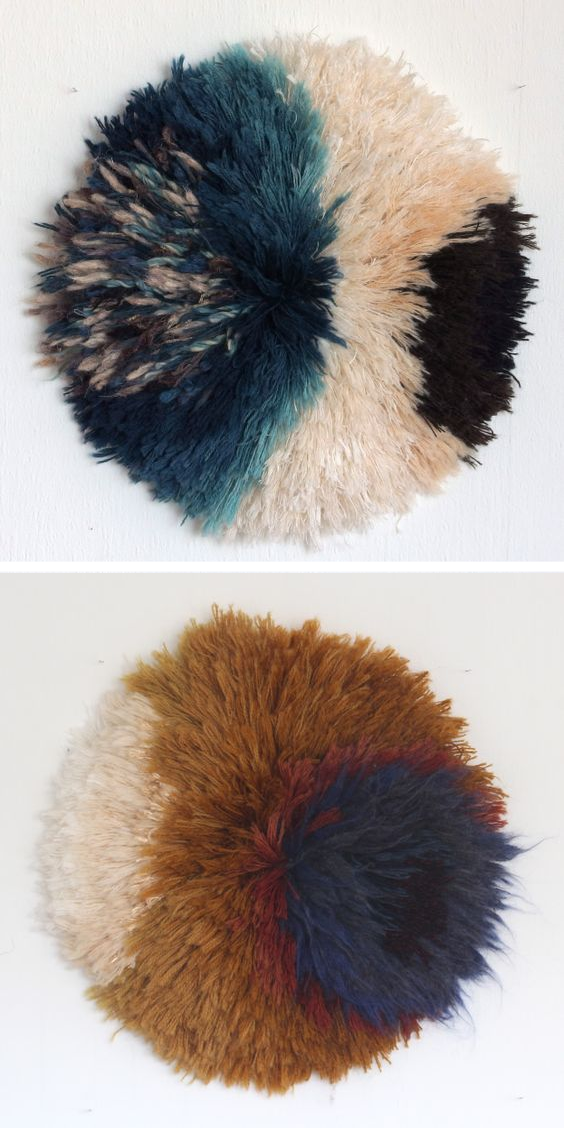
Firstly is Renilde De Penter, a Belgian textile designer who creates beautifully textured cushions and wall hangings, and by keeping the strands of yarn long it creates a pompom like pile which just begs to be touched.
The pieces are inspired by nature in all shapes and forms, including slime mould which often grows in individual hair like strands.
"Nothing in nature is entirely flat. There is texture in everything." (Renild de Peuter, Cover Magazine)
Now, technically I can't confirm that this is punch needle or tufting, the only mention of the designers method says that they use Smyrna stitch, which when you search for it is a star like stitch used in cross-stitch, however Smyrna also came up in connection with latch hooking.
A similar process to punch or tufting, latch hook, rather than leaving loops either side of the canvas instead, relies on a latched hook with a thread looped around it being pushed through the canvas - which is a far more open weave - and pulled back through the looped end of the thread and knotted onto the canvas. So rather than creating connected lines of looped stitches, you're individually knotting each thread to your canvas to create a carpet like pile.
Latch hook, punch needle, tufting, they're all related and can create a very similar aesthetic but in this case the latch hook allows de Penter to create really long, flowing organic and almost fur like textiles. They are truly beautiful, and while they're simple, the use of colour and differing textures of the threads and wools creates a really interesting textile which elevates a technique used to create carpeting to art.
The texture that can be achieved by punch needle style crafts is a huge part of their charm and appeal, and when left longer and wilder, why it can be integrated so easily into naturalistic styles of textiles.
Artist Alexandra Kehayoglou takes this to extremes, creating huge tufted landscapes out of recycled and scrap yarn.
Grasses and tufts of moss grow out of Kehayoglou's textiles, mimicking the Argentinean landscape that she grew up in and made as a comment of the impact climate change and the human species has had on those areas. From a family of carpet makers, Kehayoglou uses a mixture of hand tufting using punch needles and tufting guns to create the rugs, but each is hand trimmed by her and her team to create the undulating, naturalistic forms, and between the handmade nature and the fact that she uses recycled yarn means that every piece is unique, but the tradition is still maintained from her families practices.
“I live in a green bubble. I feel I have a purpose which is to weave more
greenery, as a reaction to the gradual disappearance of our natural world.
I’m flying the flag for mother Earth. I keep weaving to raise awareness, to
encourage others to love it as well.” (Alexandra Kehaylou, Friend of Friends)
Creating rugs as homeware and installations, they have been used for exhibitions, fashion show catwalks, and have even covered a Taipei lecture hall, creating a ground covering of Kehayoglou's textiles from floor to ceiling. These exhibition pieces completely enveloping the spaces they're being shown in, the artist creating stone walls, covered in yarn flora and mossy outcrops which are becoming progressively more and more hyper realistic...
... and they invite the viewer to interact with the pieces, because why make such tactile art if your audience must look, but not touch?
I think these are phenomenal and when I bought a punch needle (yes, of course I bought one, I'm obsessed with craft supplies), it was with the idea of creating naturalistic mossy textures, and these just make me want to make them more. They're also a great example of how important it is to pass traditional techniques down through families and craft communities, because while they're traditional, the way you use them, the message and purpose doesn't have to be. Embracing traditional techniques, as with punch needle and tufting, keeps a tradition alive but doesn't constrain the craft to the expectation of that craft.
Now, I'm going to admit that I'm putting in the delightful work of Nikitina Liubov into this list despite not being sure if it fully falls into the latch hook, punch needle, tufting category...
When searching for punch needle embroidery Luibov's motivational embroidery hoops came up frequently, but I can't find a list of techniques or methods that she uses in her work, bar mention of French knots, needle felting and polymer clay. However, the texture which she achieves on her small canvases is so reminiscent of that of a punch needle, that I'm going to include it. Plus they're beautifully stitched pieces of naturalistic embroidery no matter what technique it actually uses.
Adorned with tiny realistic critters including ladybirds, slugs, stag beetles and wasps made of polymer clay, Liubov's heavily encrusted embroidery is reminiscent of the trend a few years ago for moss graffiti on walls. As though slowly growing over time to tell us to "chill", "lighten up", or "slow down", if these aren't partially created using a punch needle I'd be surprised as the texture and cut pile stitching used are very similar to the technique.
In the end it doesn't matter if this is punch needle or a build of French knots to create this encrusted mossy texture, they're fascinating and beautifully detailed pieces of embroidery and I wasn't going to exclude them from this post for not officially having the correct technique.
Honestly, it's like people think I plan for these posts months in advance!
Moving away from naturalistic punch needle embroidery to the more graphic and illustrative, starting with the personality stuffed creations of Ina Dyreborg at Dyreborg Studios:
Dyreborg is a self taught carpet maker, her unsuccessful search for the perfect rug turning into the a very successful pursuit into making her own from scratch, and eventually becoming a fully fledged textile artist.
"I tested myself through yarn types and canvases to tuft in until I found
the materials that suited my style and temperament. [...] For me, it was
important from the start that the rugs should be more than a carpet, it
should inspire and give the desire to explore the tactile." (Ina Dyreborg)
These are pretty traditional in how the punch needle has been used, but Dyreborg's illustrative style is humorous, colourful and weird, and a far cry from the organic way the previous have used the techniques. Which is why I like them, plus they show that going from novice to professional can be as simple as just wanting the right rug and the determination to do it yourself.
Debi Hasky is a Panamanian-American illustrator, comic maker and designer based in Barcelona, who creates artwork which is bright and colourful, focusing on her own experiences of anxiety, self-esteem, insecurity.
She also doesn't shying away from talking about activism and feminism, including a series called "Call Out Catcalls" highlighting the culture women are exposed to on a day to day basis. Another constant motif in her work is one of body positivity, and her belief that we should embrace our bodies, not punish ourselves for our imperfections. Hasky's work is incredibly personal, there's no holds barred when she's talking about her emotional state, that feeling of fragility or of being lost, but it's done in an incredibly inclusive, encouraging way that makes you feel seen.
"As a whole, I hope my illustrations inspire people to embrace their
unique qualities, giving them the courage to express their emotions
[...] Know that your feelings are valid. You are not alone."
(Debi Hasky, Cosmopolitan)
Punch needling seems to have only been a recent addition to the the artists repertoire, but this Creative Juice piece spoke to that part of my brain that's so stuck when it comes to creativity. It was fun and silly and if only creativity came in drinks cartons...
"I saw my grandmother doing cross stitch on a kitchen cloth and it blew my mind.
I quickly realized that cross stitches worked in the same way as pixels. Two similar
units which came to life in different generations." (Aheneah, Visual Collaborative)
Family connection is a huge part of how lots of people get into crafts. You see someone cross stitching, knitting, drawing, painting, potting... and a little bit of your brain clicks and says that looks fun! and then after a while it goes, I'm bored of doing it the way they do it, how can I make it mine?
Ana Martins, who goes under the name Aheneah, took inspiration from her grandmother and merged her love of the traditional craft of cross stitch with her love for graphic digital art. This meant creating most of her artwork as large pixilated cross stitch installations, which she's more well known for.
However, though I'd stretched the theme a little for other artists in this post, cross stitch is a little far. The reason Aheneah features on this list is for a piece of punch needle art that she created as part of the graphic identity for WOOL 2018, an Urban Art Festival in Covilhã, Portugal.
The punch needle piece was inspired by the colour, texture and dynamic nature of street art and graffiti, but also allowed Aheneah to use the wool that the town produces. The change in technique also allowed her to build texture without compromising on the amount of detail the piece would require had she used the cross stitch installation technique, using nails or screws with yarn wrapped into the cross stitch pattern which is more usual to her.
The embroidery created is bright and graphic, it's modern but rooted deeply in the tradition of the craft and the aesthetic of urban art, and it's this juxtaposition I like. That mossy punch needle texture creating the negative of a sans serif font and the colour, I really love those colours.
This piece of graphic insanity is a part of an ongoing collaboration between Denzel Currie, known as CurrieGOAT and Bryan Perrenoud, also known more commonly as Shmoxd, in which have begun to create these weird pull apart rugs, one creating part of the design and the other completing the illusion.
I've put all of the videos for their collaboration into a playlist out of ease of access for anyone who wants to watch, but in this series the pair exchange rugs, creating half of the project before sending them across the Atlantic, from London to Utah, for the other to finish.
This pass the parcel method of creativity allow for a each rug to be taken in a completely different direction than the original creator intended, and in this case, Currie's skull rugs are transformed into the pull apart stretchy rug revealing one of Shmoxd's smiley faces, a repeat pattern in his craft projects.
I don't know how you'd display it, but it would certainly be a conversation starter.
It also shows how beginner friendly punch needle and tufting can be, Shmoxd being newer to the craft than Currie, but with desire just to "figure this whole “art” thing out" through trying, failing and trying again. As part of his YouTube content, he has multiple videos on punch needle and tufting beginning in 2018, showing the trial and error and how once you get the technique, get the knack, you can pick it up pretty quickly.
The pair have recently continued the project, creating another collaborative pull apart rug to add to the collection.
(Sorry if this section seems a little incoherent, I've not been sleeping much and last night was Story Malik, I really hate the wind and it's so loud in my room I think if I got two hours sleep if I was lucky, so my brain's not really working very well. But when it comes to this collaborative rug, I just think it's really novel and I love how graphic and cartoonishly macabre it is, I just can't seem to explain that succinctly)
The impetus for this post was people picking up creative arts and crafts during the pandemic as a way to keep themselves and their mind busy from what was going on in the wider world. Because there's only so much you can take before letting the misery in. It was about how the creative arts soothes anxiety and helps to open back up the creative parts of our brains that we've had beaten out of us through years of education.
"We are educating people out of their creative capacities… I believe
this passionately, that we don't grow into creativity, we grow out of it.
Or rather, we get educated out of it." (Sir Ken Robinson)
Being given this time out of the day to day, forced into time alone, off work and with time to think, it gave some of us the ability to be creative. It gave some of us a chance to change directions.
Toronto based artist Laura Cone was one of them, teaching herself how to punch needle during lockdown in 2020 to stave off boredom
Boredom, the need for a relatively tidy craft and Instagram, led Cone to ordering the supplies for punch needling, and she learnt the basics through online tutorials. Though she admits the learning curve was steeper than social media would lead you to believe.
Newly graduated from OCAD University in Toronto, Canada just prior to the pandemic, Cone's background was in Sculpture and Installation, but found that fibre arts added to her repertoire and quickly it became her main practice, creating unique illustrative characters with multiple eyes and drooping, slack jawed mouths, which represented her feeling towards the pandemic, "the quarantine blahs" as a CBA Arts article put it.
Under the name Indoor Activities, Cone's quarantine pastime became her career, creating rugs, wall hangings, and one off commissions, switching from handheld punch needle to a tufting gun to keep up with demand, cutting her work time drastically, and allowing her to have the hobby to from side hustle to her full-time job.
For most of the examples on this list of punch needle or tufting the artwork created by these artists has either been rugs or wall hangings, and realism has been part of some of them, but Youmeng Liu's designs are intended to show hyper realism. Her work is supposed to look edible.
Carefully mimicking the subtle colour and textures of eggs; mushrooms; Yorkshire puddings; toast; waffles; baked beans; artichokes; broccoli; popcorn and many other food items, Liu's intent is to create 301 detailed "embroidered edibles", and having already produced 22 (022/301 Baby Cauliflower being the most recent), there are a lot more to anticipate in the coming months.
Liu created her own bespoke punch needle to achieve her unique style of embroidery, finding mass produced needles on the market too big and bulky, and not fine enough to create the delicate work she was producing. And it's the nuisances in that fine detail that makes these so remarkable. The irregular burn on the toast, gills sewn into the underside of mushrooms, icing sugar dusted on a waffle, perfectly coloured, trimmed and sculpted into a full English breakfast with an embroidery hoop as a plate. They make you look twice and show just how delicate punch needle embroidery can become when much finer needles and threads are used.
An offshoot of rug/latch hooking, punch needling can be traced back to at least the 1800's, when in a bid to speed up the craft Ebenezer Ross created the first punch needle in Ohio, in 1886. This also marked the industrialisation of the craft, and made the handmade rugs incredibly sought after. By the 1950's the manufacture had moved overseas and tufting guns made the traditional punch needle craft obsolete, people not willing to spend the money on hand crafted items when cheaper mass produced alternatives existed (... it cost's that much 'cause it takes me fucking hours..."). Because of this the craft fell by the wayside until recent years, thanks largely to people on social media picking up the craft and showing it off to the world.
I wouldn't know about this craft if it wasn't for social media. The closest I'd probably seen was latch hook rugs and turkey stitch in embroidery... which if I'm honest I still can't wrap my head around. Without the online crafting community however, these sort of crafts would die out eventually and so it's wonderful to see all the creative possibilities there are, and the beautiful and weird examples that are being made by people like those in the post.
Education may steer us away from creativity over time, but social media certainly helps steer us back towards it.
Merry weekend and happy weeknight! Part ten in ten... nine... eight... seven...